


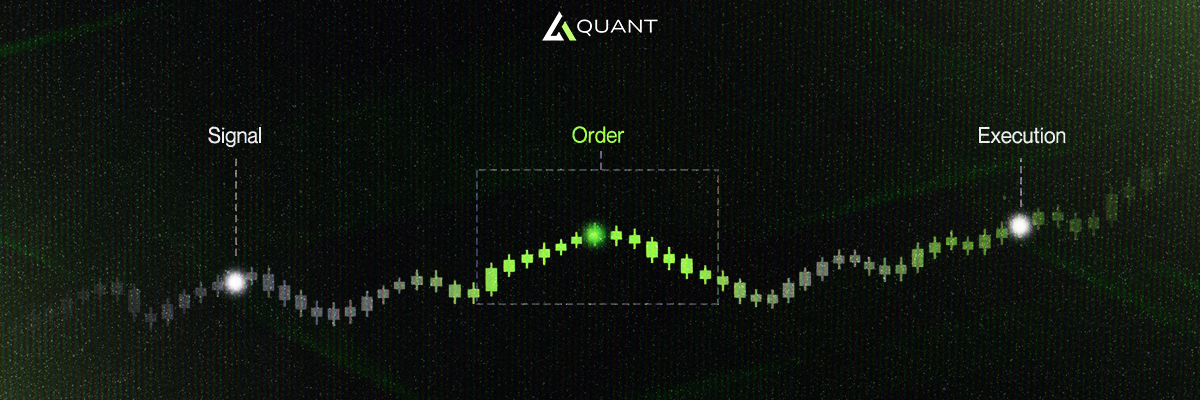
Timing influences when trading algorithms recognize an opportunity, act on a signal, and manage an open position. In cryptocurrency markets, prices, liquidity, and volatility can change quickly, so conditions that support a decision at one moment may no longer hold when the next action takes place.
However, good timing is not simply a matter of trading faster. It also involves selecting entry and exit conditions, deciding how long to hold a position, and determining whether market information is still relevant. Understanding these distinctions helps explain why different algorithmic trading strategies require different approaches to timing.
What Does Timing Mean in Algorithmic Trading?
In algorithmic trading, timing describes when a system observes market conditions, generates a decision, and carries out an instruction. Two related concepts are market timing and execution timing. Market timing concerns whether the conditions for entering, adjusting, or exiting a position are present. It does not require predicting the exact top or bottom of a price movement; instead, an algorithm evaluates whether current information meets its strategy's criteria.
Execution timing concerns what happens after a decision has been made, including when an order is submitted and filled. A signal can be valid when generated but become less useful before execution if the market changes. While execution quality also depends on liquidity and trading costs, the timing question is whether the order still reflects the circumstances behind the original decision.
Timeframes add another dimension. Some strategies react to changes over seconds or minutes, while others evaluate developments across hours or days. A short-term strategy may be sensitive to small delays, whereas a longer-term system may prioritize the persistence of a broader trend. Neither is automatically better; timing needs to match the strategy's purpose.
How Timing Shapes Trade Entries, Exits, and Holding Periods
An algorithm's entry rules define when it may open a position. These rules can use price levels, momentum, volatility, or combinations of indicators. For example, a momentum strategy may wait for a directional movement to meet a specified condition, while a mean-reversion strategy may monitor how far price has moved from an estimated reference level. Acting before the required conditions appear can undermine the original strategy, but waiting until they have changed can make a signal less relevant.
Exit timing deserves equal attention. An algorithm might close or reduce a position when a target is reached, a risk threshold is breached, a holding period ends, or the conditions supporting the trade weaken. Exiting earlier than its rules prescribe can be as inconsistent with the strategy as remaining exposed after a valid exit condition has appeared. Entry and exit logic should therefore be designed and evaluated together.
The holding period is the time between opening and closing a position. Short holding periods can increase sensitivity to transaction costs and small market movements, while longer periods expose a position to more developments over time. A suitable holding period depends on what a strategy aims to capture and how it manages risk, not on a universal rule about how long a trade should last.
Why Timing Matters in 24/7 Cryptocurrency Markets
Many cryptocurrency spot markets operate continuously, but trading activity is not equally intense throughout the day. Liquidity, spreads, volatility, and participation can vary by asset and exchange. Important announcements or sudden market movements can occur outside the business hours familiar to participants in traditional financial markets.
For trading algorithms, this means an opportunity cannot be judged by the clock alone. A particular hour may coincide with favorable conditions for one strategy but unfavorable conditions for another. An algorithm evaluating a potential trade should consider the market state it can observe, including whether prices are moving rapidly and whether enough liquidity is available for its intended activity.
Continuous trading also creates operational demands. Monitoring, data feeds, and risk controls may need to function across different periods of activity. The relevant question is not whether a system can trade at any hour, but whether it can recognize when its own trading conditions are met.
Why Signal Freshness Matters as Much as Speed
Every trading signal is based on information available at a particular time. A price breakout, momentum reading, or volatility estimate may be informative when observed, but its meaning can change as new data arrives. A signal that once satisfied a strategy's entry rules may no longer do so after a sharp price movement or a shift in liquidity.
Algorithms can address this through signal-validity rules. A strategy may require its conditions to remain true when an order is considered, reassess a signal after a defined interval, or disregard it if the market moves beyond an acceptable range. The appropriate rules depend on the timeframe and purpose of the strategy. A short-term signal may lose relevance quickly, while an observation about a broader trend may remain meaningful for longer.
It is also useful to distinguish data delays from execution delays. Data delays affect when information reaches a model or when a signal is generated. Execution delays arise after an instruction has been produced, as an order is transmitted, acknowledged, or filled. Tracking these stages separately helps identify whether an unexpected result came from outdated information, changing market conditions, or the order-handling process. Faster processing can reduce some delays, but it cannot make a weak or invalid signal more reliable.
How Timing Differs Across Algorithmic Trading Strategies
High-frequency and short-term strategies may respond to small changes in price, spreads, or order-book conditions. Their opportunities can be brief, making timely data and order handling especially important. Because these approaches may trade frequently, fees and other execution costs must also be considered when evaluating whether a signal was worthwhile.
Momentum and trend-following strategies look for directional movement. Their timing rules may assess when a trend has become sufficiently established and when evidence of that trend begins to weaken. Entering early can expose the strategy to false starts, while entering later may mean that part of the movement has already passed. There is no guaranteed point at which a trend will begin or end.
Mean-reversion strategiesevaluate deviations from a reference level, such as a moving average or a statistical estimate. Timing matters because a price can continue moving away from that reference instead of returning promptly. A large deviation alone does not establish when a reversal will occur, or whether it will occur at all.
Longer-term systematic strategies may use daily or broader observations and place less emphasis on minor processing delays. They still require timely data and clearly defined exits, but their evaluation is more closely tied to whether wider market conditions remain consistent with the strategy's assumptions. These differences show why there is no single timing method that suits every trading algorithm.
How Can Trading Algorithms Evaluate Timing Effectiveness?
Timing decisions should be evaluated across many observations rather than judged by a few well-timed trades. Backtesting allows researchers to apply entry, exit, and holding-period rules to historical market data and examine how results vary across different conditions. It can also help compare alternative timing parameters, provided those comparisons account for the risk of overfitting to past observations.
The historical test must reflect what the algorithm could actually have known at each decision point. Using a completed candle before it would have closed, for example, introduces look-ahead bias. Unrealistic assumptions about order fills, processing delays, and transaction costs can also make timing rules appear more successful than they would be in live trading.
Live evaluation adds another layer of evidence. Signal-generation timestamps, order-submission times, fill records, holding periods, and transaction costs help explain how a planned decision became an actual trade. Comparing these records can reveal whether the strategy entered or exited under its intended conditions, and whether delays or execution costs contributed to a different result. No single favorable trade proves that a timing method is dependable; consistency and risk matter too.
The Relationship Between Timing and Risk Management
Timing determines when a strategy takes on market exposure and how long that exposure remains in place. A delayed entry, unexpected increase in volatility, or slower-than-expected exit can leave a position operating under conditions different from those originally anticipated. These changes may affect the suitability of an existing signal or the risk of holding a position.
Time-based controls provide one way to set boundaries. Examples include signal expiration periods, maximum holding times, and restrictions on opening positions when required information is stale. Other controls may monitor exposure, volatility, or position limits and prompt a predefined response when conditions move outside acceptable ranges.
Such controls do not eliminate uncertainty or ensure that every position will be closed at a favorable moment. They help make timing decisions consistent with a strategy's assumptions and provide a clearer basis for responding when those assumptions no longer hold.
The Role of Trading Infrastructure in Timing and Decision-Making
Effective timing in algorithmic trading depends on how well market analysis, trading decisions, and execution processes work together. Trading systems need access to relevant market information, while operational infrastructure must support the execution and monitoring of approved trading instructions. Connecting these functions helps traders evaluate whether decisions were made under appropriate conditions and how those decisions translated into actual market activity.
TA Quant Intelligence: Supporting Market Analysis and Timely Decisions
TA Quant Intelligence serves as the market-intelligence and decision-support layer, providing analytical context around market conditions, trading signals, and strategy suitability. Through market regime analysis, risk monitoring, and quantitative research capabilities, it supports the evaluation of whether prevailing conditions align with a strategy's objectives.
In the context of trading timing, this information helps traders assess the relevance of market signals as conditions evolve. Rather than predicting the exact moment to enter or exit a trade, TA Quant Intelligence supports more informed evaluations of market opportunities and the factors that may influence their timing.
TA Terminal: Supporting Trade Execution and Timing Visibility
TA Terminal provides the operational infrastructure for strategy management, multi-venue execution workflows, and trade monitoring. Once a trading instruction has been approved, the execution layer supports order handling while maintaining visibility into trading activity and execution outcomes.
Through internal APIs and data interfaces, execution information such as order timestamps, fill records, latency, and trading activity can be connected with the original analytical context. This allows traders to review how timing differences between signal generation and order execution may have influenced realized outcomes.
Together, TA Quant Intelligence and TA Terminal connect market analysis with execution and monitoring. By keeping these functions distinct but integrated, the architecture supports a more structured approach to evaluating trading timing without guaranteeing optimal entries, exits, or trading outcomes.
Common Misconceptions About Trading Timing
A common assumption is that faster always means better. Speed matters when an opportunity is short-lived, but acting quickly on unsuitable information can still produce an unfavorable result. Another misconception is that algorithms should trade whenever markets move. In practice, remaining inactive may be consistent with a strategy when its required conditions are absent.
Successful timing in historical data also does not guarantee similar results in future markets. Different volatility, liquidity, or trading costs can alter how the same rules perform. Timing is best understood as a strategy-specific process that must be tested, monitored, and reviewed rather than a method for identifying perfect moments to trade.
Timing Is More Than Trading Speed
Timing shapes how trading algorithms interpret signals, choose entries and exits, manage holding periods, and respond to changing conditions. Its importance differs across strategies, making market context, information freshness, and risk controls as relevant as processing speed.
Effective algorithmic trading is therefore not simply about acting first. It is about making decisions when the strategy's conditions are met, understanding how those decisions are carried out, and evaluating the outcomes with reliable data and disciplined oversight.